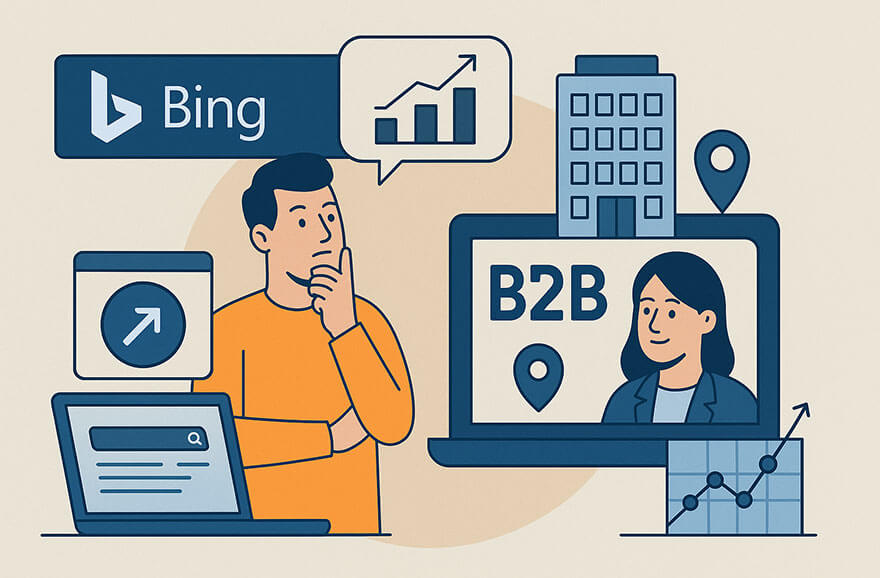
Everyone optimises for Google. But should you be giving Bing more love too – especially if you’re in B2B?
If Bing isn’t currently part of your SEO strategy, you’re not alone. Google still dominates the search market, but for B2B brands in particular, ignoring Bing in your SEO strategy could mean leaving quality traffic and leads on the table.
Optimising for Bing doesn’t have to be a massive overhaul. Reviewing your visibility, submitting your site to Bing Webmaster Tools, and tweaking a few on-page elements could yield surprisingly strong results.
Let’s unpack why Bing deserves a second look, and how B2B brands in particular can benefit from showing up where their competitors might not be…
1. Bing has a bigger slice than you think
While Google grabs around 90%+ of global search traffic, Bing still accounts for roughly 3-7%, depending on the region – and even more in enterprise-heavy verticals.
This is because, among other reasons, Bing enjoys a number of prominent placements:
- Default status on Windows devices using Microsoft Edge
- Built into Microsoft 365 environments
- Prominent on workplace desktops where corporate IT departments don’t allow Chrome or browser switching.
That means that if your target audience includes office-based professionals, decision-makers or IT buyers, they could be searching on Bing without even thinking about it.
2. Bing users tend to be older, wealthier, more B2B-focused
According to Microsoft data, Bing’s audience:
- Skews 35+
- Has a higher household income on average
- Is often in professional or managerial roles.
These are the sort of people who make buying decisions – not just Google searchers looking for ‘how to fix my printer’.
So if your product or service is aimed at businesses, software buyers or professional services, Bing could be delivering untapped, qualified traffic.
3. Bing SEO is less competitive
Because most brands focus their efforts on Google, Bing’s search results can be a lot less saturated. That means:
- Lower keyword competition
- Easier rankings for long-tail queries
- Higher visibility for well-structured content.
It all means that you might get better ROI on your SEO efforts in Bing with far less effort.
4. Your Google optimisations still work on Bing (mostly)
The good news for SEO teams that have been focusing on Google up to now is that Bing isn’t a totally different beast. Many of the SEO best practices you already know still apply:
- Clean URL structures
- Keyword-rich content
- Fast-loading, mobile-friendly pages.
But there are some quirks. Bing gives more weight to:
- Exact-match domain names
- Older domains with established backlinks
- Schema markup (even more so than Google)
- Social signals and content engagement.
5. Don’t forget Bing Webmaster Tools
Google Search Console’s lesser-known cousin, Bing Webmaster Tools, gives you:
- Crawl and index data specific to Bing
- Backlink analysis
- SEO reports and diagnostics.
Note too, that you can import your Google Search Console setup straight into Bing’s platform to get started quickly.
6. Consider Paid and Organic Together
Microsoft Advertising (formerly Bing Ads) lets you run PPC campaigns across Bing, Yahoo, and AOL search properties. For B2B advertisers, it’s a lower-CPC, high-intent channel that’s well worth testing.
Aligning your organic Bing SEO efforts with a small paid campaign can give you visibility on both fronts, and will also provide useful conversion data to guide future optimisation.Want to expand your visibility? At Chillibyte, we help brands find the blind spots in their digital strategy. If you’re interested in making Bing work harder for you, get in touch today